

Disclaimer: Our content doesn't constitute medical or fitness advice. We may be earning money from companies & products we review. Learn more

Table of Contents
- 1 What is the Australian Pull Up?
- 2 Australian Pull-Up Muscles Worked
- 3 How to do the Australian Pull-Ups?
- 4 Australian Pull-Up Benefits
- 5 Mastering Australian Pull-Ups
- 6 Skills Required for Mastering Australian Pull-Ups
- 7 Benefits of Advanced Australian Pull-Ups
- 8 Master the Australian Pull-up Today!
- 9 Australian Pull-Up Video
- 10 All Pull Exercises
What is the Australian Pull Up?
Diversifying your upper body workout routine is essential for overall strength development, and the Australian pull-up comes as a highly effective and accessible exercise. It’s a movement I use with all of my personal training clients who are looking to achieve their first strict pull-up.
Also known as body rows or inverted rows, Australian pull-ups offer a unique approach to targeting your back, arms, and core muscles. Funnily enough, they’re referred to as Australian pull-ups because they start from down under the bar. If you want a deeper breakdown (variations, grips, and progressions), see our complete guide to bodyweight rows.
Now, let’s explore the mechanics of the Australian pull-up, discuss the skills needed to perform it successfully, and dive into the benefits it can bring to your training.
Australian Pull-Up Muscles Worked
The Australian pull-up targets your upper body muscles including the latissimus dorsi, biceps, rear deltoids, mid-back muscles (rhomboids and traps), plus your forearms and grip. Your abs, glutes, quads, and hamstrings also work, mostly as stabilizers, since you need full-body tension to keep your body in a straight line.
The Men’s Health article suggests the Australian pull-up is a great exercise for strengthening back muscles to support better posture, especially for those who spend most of the day sitting. I agree, and this should be included in your pull workouts.
How to do the Australian Pull-Ups?
1. Body Position
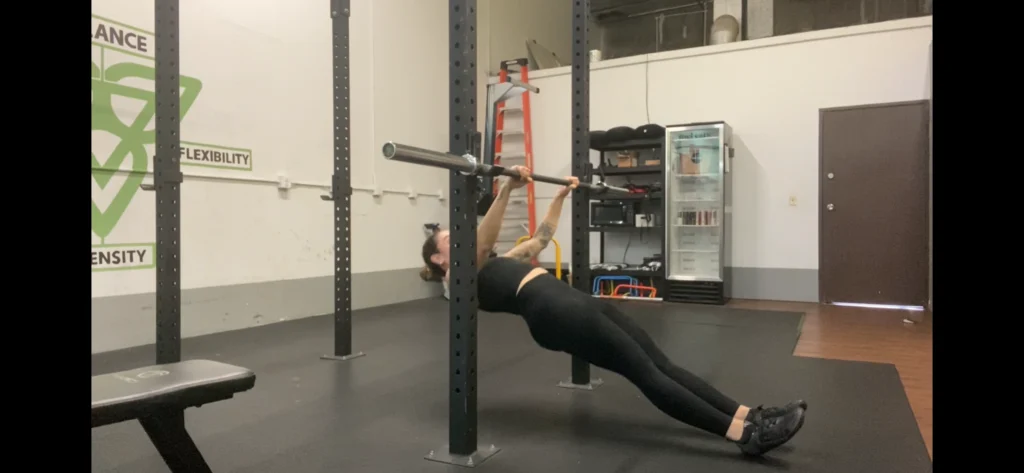
Position yourself under a low bar with your hands gripped tight at shoulders-width apart, and arms straight. Line your shoulders with the bar so that when you pull up, your middle chest touches the bar. Straighten your body out by keeping your feet together, and recruit your glutes and quads to keep your body tight. Your body should be at an inclined slope.

2. Grip The Bar Tight
There are many grip variations you can do to perform this exercise, but for now, start with a tight pronated grip shoulder-width apart with your thumbs underneath the bar. Stay in an active hang with your shoulders controlled (do not shrug up to your ears). This gives your shoulders more support and helps you produce more power.
You can use different grip positions and widths to shift the challenge. A closer grip often emphasizes biceps a bit more and can feel easier for higher reps. A wider grip tends to challenge your upper back more. Pronated grip usually hits more upper back, while a supinated grip typically feels more biceps heavy.

3. Pull Straight To Your Chest
Exhale as you pull the bar straight to your chest and engage your rear deltoids and your biceps, whilst keeping your body in a straight line. You should feel resistance in your upper body muscle groups such as the upper back, chest, shoulders, and arms doing the work, as well as the lower body muscles, the glutes, quadriceps, and hamstrings.

Retract Your Scapulas
As you pull up, make sure to retract your scapulas (pulling your shoulder blades together) as this will improve the muscular contraction and strengthen your shoulder blades. Other than this, it will assist in improving your posture and create efficient arm movement and joint stability.
If you struggle to feel this, build the skill directly with scapula pull-ups. It is one of the fastest ways to clean up your pulling mechanics.
4. Return To Your Starting Position.
Inhale as you lower down into a starting position, and lock both elbows out before pulling back up. This maintains a full range of motion which will result in better muscle balance, joint stability, proper activation of working muscles, and overall better movement quality.

Quick Form Checklist (Use This Before Every Set)
- Body tight: squeeze glutes, keep ribs down, no hip sag.
- Neck neutral: look straight up, not cranked forward.
- Lead with chest: chest to bar, then elbows drive back.
- Full range: elbows locked at the bottom, chest close to the bar at the top.
Australian Pull-Up Benefits
Increases Grip Strength
The Australian pull-up is great for building the anterior and posterior muscles of your forearms. Your grip strength is important because you require it for almost every activity, whether it’s opening a door or lifting up a box. One of the most efficient ways to unlock higher reps, bigger pulls, and better training gains often starts with grip.
Target Your Middle Back
The muscles that are in use in the middle of your back are the traps, rhomboids, and lats. This is great for those who are looking to sculpt their body and build muscle. Don’t be surprised if your back feels sore during the day you perform lots of Australian pull-ups, and even more sore the following day. This is a normal response when you expose your back to a new stimulus or higher volume.
Minimal Equipment Needed
The Australian pull-up can be performed almost anywhere with minimal equipment. You can perform this exercise using a doorway pull up bar, a low bar at the park, the side of a dip bar, gymnastics rings, TRX, or any sturdy elevated surfaces in your home (such as two chairs parallel to each other or even under a solid four-legged table). You can train almost anywhere using only body weight, and that is calisthenics at its best.
A Progression For The Pull-Up
This progression has a significant role in achieving and strengthening your pull-ups and increasing your repetitions. It works on the same muscle groups as traditional pull-ups. With every repetition, you are building the pulling pattern, scapular control, and upper back strength that carries over to strict pull-ups.
If your main goal is your first pull-up (or turning 3 reps into 10), follow our 20 pull-ups in 60 days progression plan and use Australian pull-ups as one of your main builders.
What is the difference between the Australian Pull Up and the Pull Up?
The Australian pull-up is an exercise that is used as a progression toward achieving the pull-up. With the Australian pull-up, you are pulling your body horizontally upwards, which makes this exercise easier since there is less load on the upper body as your legs are on the ground, taking most of your weight away from your upper body.
Whereas, with pull-ups, you are pulling your body vertically upwards without the assistance of your legs which increases the load on the upper body, therefore creating more resistance on the muscles. Australian pull-ups can also help posture by strengthening the muscles that support better shoulder positioning, especially when you do them with controlled scapular retraction.
One important correction here: the 2020 paper linked above is a study protocol describing a 24-week plan for time-efficient resistance training using simple movements (including rows, squats, and push-ups). It supports the idea that simple strength training can be practical and scalable, but it does not publish the final results inside that paper.
For a reliable big-picture guideline on why strength training matters for health, the CDC recommends adults do muscle-strengthening activity at least 2 days per week (in addition to weekly cardio). See: CDC adult activity guidelines.
Mastering Australian Pull-Ups
For more advanced athletes, you may want to take your Australian pull-up to the next level by adding weighted resistance or by performing more methodical repetitions. This section is for more seasoned athletes looking to make further progress on their Australian pull-up.
- Setup: Position yourself under the bar, lying on your back. Reach up and grab the bar with an overhand grip, hands slightly wider than shoulder-width apart.
- Body Position: Keep your body straight, forming a plank-like position from head to heels. Your heels should be on the ground, and your arms fully extended, supporting your weight. No sagging hips or shoulders.
- Advanced Techniques: Wear a weighted vest to add resistance, or ratchet up the difficulty by placing your feet securely on a folding chair.
- Pulling Motion: Initiate the movement by pulling your chest towards the bar. Focus on squeezing your shoulder blades together while maintaining a straight line from head to heels.
- Hold and Lower: Once your chest reaches the bar, hold the position briefly to maximize muscle engagement. Lower your body back to the starting position in a controlled manner, ensuring a smooth descent.
- Repeat: Perform multiple repetitions, concentrating on the quality of each movement. Gradually increase the intensity by adjusting the difficulty level or adding resistance as you gain strength.
How to Progress Faster (Without Getting Fancy)
- Step 1: Hit 3 sets of 10 clean reps at your current bar height.
- Step 2: Lower the bar slightly (or walk your feet farther forward) to make the angle harder.
- Step 3: Add a 1 to 2 second pause at the top with your chest close to the bar.
- Step 4: Add a slow 3-second descent for 6 to 8 reps if you want more muscle growth.

Skills Required for Mastering Australian Pull-Ups
Australian pull-ups are accessible to individuals at various fitness levels, making them an excellent option for beginners and advanced athletes alike. Here are the skills required to perform Australian pull-ups effectively:
- Core Stability: Maintaining a straight body or hollow body position throughout the exercise necessitates core stability. Strengthen your core with exercises like planks and hollow holds to enhance your ability to control your body during Australian pull-ups. Making sure to pull your rib cage down and your pelvis in a neutral spine to align properly is best to keep that core as strong as it can be.
- Basic Upper Body Strength: While Australian pull-ups are more accessible than traditional pull-ups, having a basic level of upper body strength is beneficial. Incorporate exercises like push-ups and bicep curls into your routine to build foundational strength.
- Scapular Awareness: Similar to other pull-up variations, being mindful of your scapular movement is crucial. Focus on proper scapular retraction and depression during the pulling motion to engage the targeted muscles effectively. If your upper back is the weak link, add this once a week: our upper back workout guide.

Benefits of Advanced Australian Pull-Ups
- Upper Body Muscle Engagement: Australian pull-ups engage a variety of upper body muscles, including the back, biceps, and shoulders. This comprehensive activation contributes to a well-rounded upper body development.
- Scapular and Shoulder Health: The controlled movement in Australian pull-ups promotes scapular retraction and shoulder stability. This can be particularly beneficial for individuals looking to improve posture and reduce the risk of shoulder injuries.
- Accessible for Beginners: Australian pull-ups provide a beginner-friendly alternative to traditional pull-ups. They allow individuals to build strength progressively, making them an excellent starting point for those new to bodyweight exercises.

- Versatile Exercise: The versatility of Australian pull-ups allows for difficulty adjustments. You can modify the exercise by changing the angle, adding resistance, or incorporating single-arm variations to continually challenge yourself.
Master the Australian Pull-up Today!
Whether you’re a fitness enthusiast looking to diversify your routine or a beginner seeking an approachable upper-body exercise, Australian pull-ups offer a valuable solution. It’s a fairly simple exercise, and one that can be mastered in a relatively short period of time.
By incorporating this movement into your workout regimen, you can enhance your upper body strength, improve scapular and shoulder health, and enjoy the versatility this exercise brings to your fitness journey. Start at your own fitness level, focus on the proper form I’ve outlined above, and gradually progress as you build strength and confidence in your abilities.
To help make progress on your Australian pull-ups, consider the following helpful accessory movements:
As always, Gymless Heroes, be sure to consult with a qualified professional before starting a new fitness routine. For a more one-on-one approach to learning the Australian pull-up, or any other calisthenics movement, hit me up for a free 30-minute consultation.
Australian Pull-Up Video
See Pad Chadwick, our head instructor, demonstrate the Australian Pull-Up at a local calisthenics park.

Extra Reading (Trusted Sources)
- CDC: Physical activity guidelines for adults
- PubMed: Physical Activity Guidelines for Americans (summary paper)
All Pull Exercises

I’m Pat Chadwick, a qualified Level 2 and Level 3 calisthenics coach and certified personal trainer from London, England. I have over six years of experience training students specifically in the art of calisthenics. I’ve competed in various UK competitions, including the Kalos Stenos Championships, where I achieved third place in the lightweight category. My passion is highlighting the beauty of calisthenics as an authentic and pure form of body expression. I believe that everyone has the potential to become a champion of their body and mind, and that calisthenics opens the door to personal empowerment.